
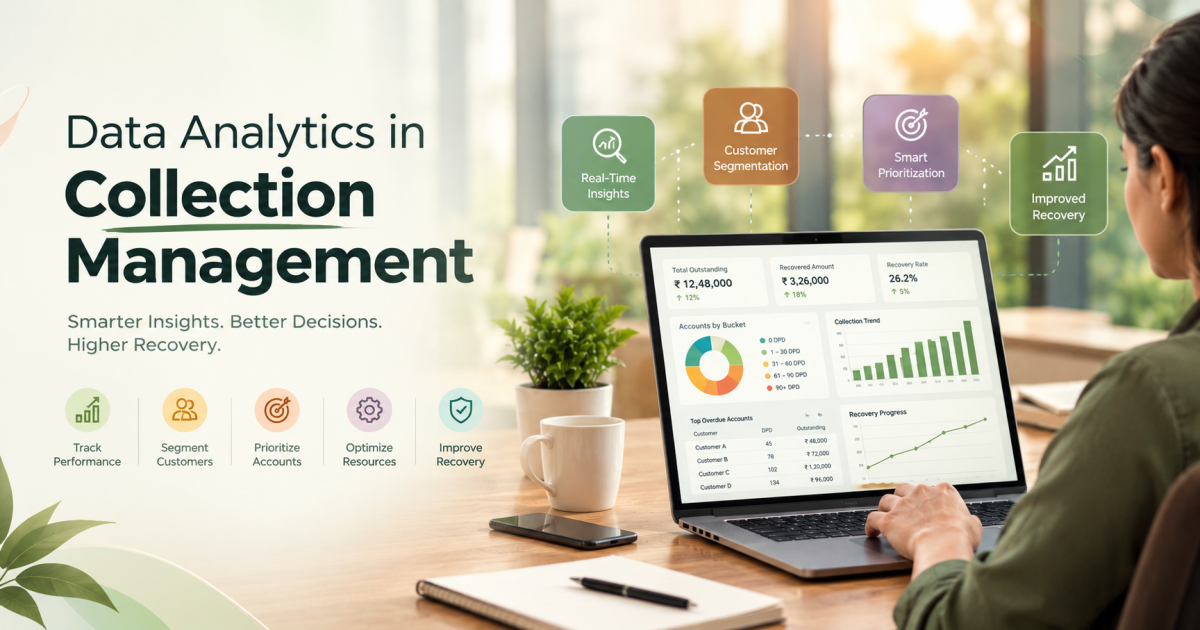
Data Analytics in Collection Management
The financial services industry is getting more and more data-driven. With portfolios getting larger and consumer behavior diversifying, the use of conventional collection techniques alone may become insufficient for sufficient visibility into collections portfolios. More and more financial institutions, NBFCs, fintech companies, and even collections agencies implement data analytics in collection management to gain more insights into accounts, prioritize activities, and make their operations more efficient.
Data analytics can be used to help collections teams structure and understand large amount of information related to accounts.
By analyzing such information as payment history, DPD, collection buckets, interactions with customers, outstanding amounts, recovery performance, etc., financial organizations will be able to get more structured collection strategies.
Data Analytics in Collection Management
Data analytics in collection management means the collection, structuring, analysis, and interpretation of information related to overdue accounts and collection efforts.
Collections teams may work with such information as:
- Payment history
- Outstandings of loans
- DPD and delinquency status
- Collection bucket
- Previously performed interactions
- Payment promises
- Follow-up records
- Recovery amounts
- Field visit results
- Status of resolution of account
With a correct analysis of this information, the managers will be able to get a better understanding of their portfolio.
Why Is Data Analytics Important for Modern Collections?
Manual management of thousands or millions of loan accounts may be difficult for collections teams. However, data analytics can help organizations structure their activities and get a systematic way of identifying patterns and organizing accounts according to their collection needs.
In this way, organizations can distinguish between accounts and organize their collection activities according to the portfolio features.
1. Better Customer Segmentation
One of the uses of data analytics in collections is account and customer segmentation.
All overdue accounts do not have the same characteristics. While one customer may have missed a payment, another one might have a history of delinquencies.
Analytics can help financial organizations segment their portfolios according to the following criteria:
- DPD
- Type of loans
-
Outstandings
- Payment history
-
Collection bucket
- Previous payment behavior
-
Follow-up status
-
Geographic information, where applicable and lawful
- Better Bucket-Wise Collection
Data analytics can be also used in bucket management.
Accounts can be organized according to their DPD and delinquency categories. For instance, an organization may have three buckets for early, mid, and late collections.
Analytics can help collection managers analyze:
-
Number of accounts in each bucket
- Outstandings by bucket
- Recovery amounts by bucket
- Progression between buckets
-
Follow-up status
- Trends in resolution
Such information will help organizations identify accounts which are moving to further delinquency stages and organize their collections activities.
3. Helps Prioritize Collection Activities
Collection managers always have limited resources and time. Using data analytics, they will be able to find out which accounts need attention due to some defined criteria and available information about accounts.
For example, an organization may prioritize accounts according to the following criteria:
DPD + Outstandings + Payment history + Follow-up status
It doesn’t mean that all accounts should be treated only according to the data score. Human judgment, customer circumstances, policies and legal requirements are always the part of the collection management.
4. Helps to Initiate Early Intervention
Early identification of payment delays will allow organizations to initiate communication at an early stage.
Using dashboards, the managers will be able to identify new overdue accounts which require follow-up actions.
Such activities may include sending reminders, initiating communication with consumers, etc.
The goal of such activities is the timely resolution of overdue accounts and prevention of unnecessary progression to later delinquency stages.
5. Helps to Plan Field Collection Operations
Data analytics can also be used in field collections.
Before starting field activities, an organization will be able to analyze such information about account as payment history, previously performed follow-up actions, address information, outstanding amounts, prior visit outcome, etc.
In this way, organizations will be able to plan field activities in a more efficient way.
During field visits, collectors will be able to record their outcomes in a digital form, thus helping managers to monitor:
-
Number of visited accounts
- Interaction status
-
Payment promises
- Follow-up requirements
- Resolution status
-
Failure to visit
In this way, there will be a better visibility of field teams and collection managers.
6. Allows Monitoring Collections Performance
Data analytics provides the managers with measurable performance indicators.
For example, they will be able to track the following indicators:
-
Total outstanding amount
- Amount of recovered money
- Recovery rate
- Number of accounts which were resolved
- Efficiency of collections
-
Movement between buckets
- Fulfillment of payment promises
- Outcome of field visits
Regular performance tracking will help managers to understand how things are going in their collections operations.
7. Identifies Trends in Collection Activities
Large datasets may have patterns which may not be seen manually.
Analytics will help organizations to identify trends in:
- Payment delays
- Progression to later delinquency stages
- Recovery performance
- Customer reaction patterns
- Collections activities
- Overall portfolio performance
Such information will help in making plans for collection activities and adapting to changing portfolio conditions.
8. Helps to Allocate Resources Efficiently
Collections involve a lot of teams such as tele-collections executives, field collection teams, supervisors, managers, etc.
Analytics can help managers to understand how the workload is distributed and to allocate resources according to portfolio conditions.
For example, if a certain bucket has a lot of accounts, the manager will be able to look at available resources and organize activities.
This will help to organize collections in a more efficient way and eliminate unnecessary manual work.
9. Provides More Structured Reporting
Traditional reporting of collections may involve large spreadsheets with manually collected data.
With data analytics technology, organizations will be able to bring the important information from collections operations into dashboards.
Thus, managers will be able to see the following information in one screen:
Account → DPD → Collection Bucket → Follow-Up → Payment → Recovery → Resolution
This will give a more connected view of the collections life cycle.
Automatic generation of reports will reduce a lot of unnecessary manual work and managers will get up-to-date information about operations.
The Role of Technology in Data-Driven Collection
The data analytics works in the best way with appropriate technology.
Advanced collections management platforms may integrate the following pieces of information into one centralized system:
Information about accounts
- Records of communication with consumers
- Information about payments
- Field activities
- Information about collections results
Thus, dashboards will be able to provide visual summaries of collections performance and analytics will help to identify patterns and to monitor portfolio movement.
However, technology should support the process, but not to replace professional collections practices. Customer communication, proper handling of customer information, proper documentation, and compliance with laws and regulations are always the parts of collection operations.
Data Privacy and Responsible Use of Data
Data-driven collections involve a responsible handling of customer information.
Organizations should collect, store, access, and use customer information according to the applicable privacy requirements, contract terms, internal policies, and regulatory standards.
Access controls, proper documentation, data security, and appropriate authorization will help to keep customer information safe.
The responsible management of customer information is an important part of building reliable collections operations.
How DMT Supports Modern Collection Management
Dealz Management Technologies Pvt. Ltd. (DMT) concentrates on structured and technology-driven collection and recovery operations.
Modern collections management can combine data, technology, customer communication, field operations, and performance monitoring in order to get a more organized recovery process.
Data analytics will help collections teams to have a better visibility into their collections portfolios and identify account-level and portfolio-level trends. With the help of structured collection processes, such information will be beneficial for making planning and organizing activities.
The Future of Data-Driven Collection Management
With increasing adoption of digital technologies in financial services, data analytics will stay an important part of collections operations.
Organizations will be able to use the centralization of data, dashboards, automation, analytics, and other technologies for improving visibility of their portfolios.
The future of collections operations is likely to be focused on the combination of:
Data + Technology + Human Expertise + Professional Communications + Responsible Processes
Such combination will help organizations to build collections operations which are more structured, measurable, and responsive to portfolio conditions.
Conclusion
Data analytics is becoming an important part of modern collection management. With its help, financial organizations will be able to understand behavior of accounts, segment portfolios, analyze DPD and collection buckets, prioritize activities, plan field activities, and track recovery performance.
Instead of only relying on manual processes, organizations will be able to use data-driven insights in order to get better visibility and make decisions.
With the help of technology, professional customer communications, data protection practices, and structured collection processes, data analytics will make collections operations more efficient and organized.
1. What is data analytics in collection management?
Data analytics in collection management is the process of collecting, organizing, and analyzing information related to overdue accounts and collection activities. It helps financial institutions understand payment history, DPD, collection buckets, outstanding amounts, and recovery performance to make better decisions.
2. How does data analytics improve collection management?
Data analytics improves collection management by helping teams prioritize overdue accounts, identify payment delays, monitor recovery performance, plan follow-ups, and allocate resources efficiently. It also provides better visibility into collection operations through reports and dashboards.
3. How does data analytics help with bucket-wise collection strategies?
Data analytics helps categorize accounts according to Days Past Due (DPD) and delinquency stages, such as early, mid, and late collection buckets. It allows managers to track outstanding amounts, recovery rates, account movement, and follow-up status to plan suitable collection activities.
4. What are the key performance indicators (KPIs) used in collection analytics?
Important collection KPIs include total outstanding amount, amount recovered, recovery rate, number of resolved accounts, collection efficiency, movement between collection buckets, fulfillment of payment promises, and field visit outcomes. These indicators help managers evaluate collection performance.
5. How does technology support data analytics in collection management?
Technology supports data analytics through centralized collection systems, automated reports, digital dashboards, and integration of account details, customer communication records, payment information, and field activities. These tools help collection teams monitor performance, identify trends, and organize operations more efficiently.