
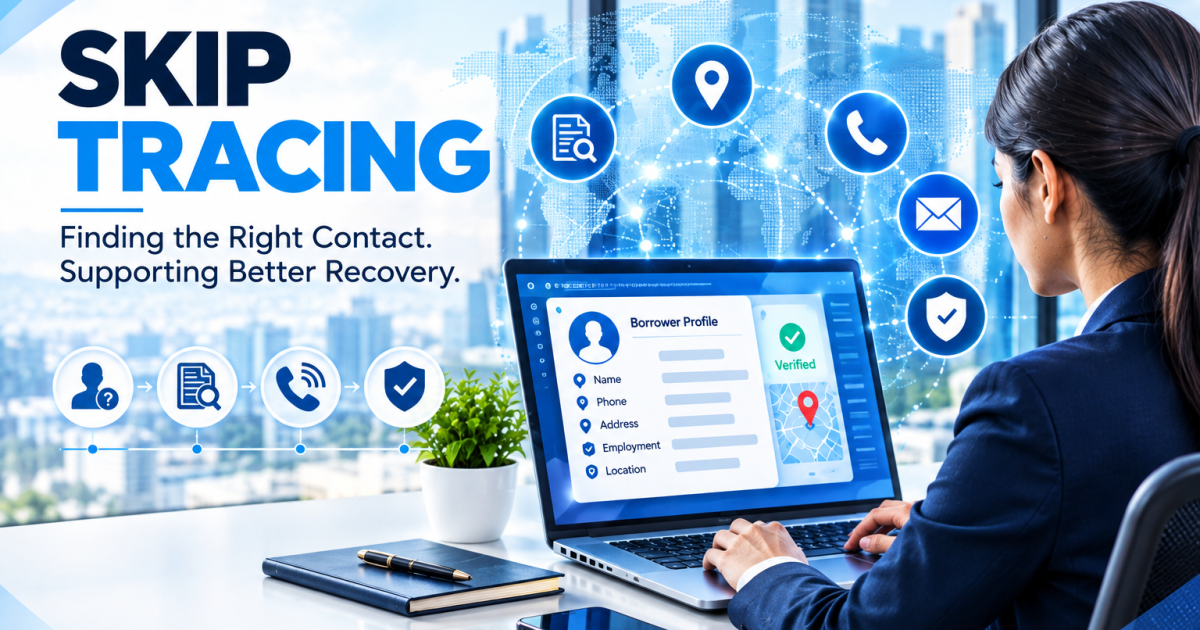
What Is Skip Tracing? How It Helps in Debt Recovery
Borrower contact information is a vital asset in loan management and debt recovery. Nevertheless, financial institutions may encounter situations when it becomes impossible to reach out to the borrower because he/she has changed his/her phone number, address, work or place of residence.
Here comes the need for skip tracing – identification and validation of relevant data in order to establish legitimate contact with a person whose contact details are no longer available.
In finance industry, skip tracing may be used in debt recovery, loan collection, NPA management, and borrower communication. Financial institutions, including banks, NBFCs, fintech lenders, etc., may use skip tracing to reduce the number of non-contactable accounts and streamline their recovery process. All this should be done in accordance with proper data handling, verification, protection and compliance.
What Is Skip Tracing?
Skip tracing means the process of finding or validating relevant information that will help to establish contact with a person whose current contact details are not available.
The borrower can become hard-to-reach because:
- He/she has changed the mobile number
- Moved to a new address or city
- Changed the workplace
- Relocated the business
- Provided incomplete or outdated information
A structured skip tracing process helps the recovery team to validate available information and identify ways to restore communication.
Skip Tracing in Debt Recovery:
As part of the debt recovery process, skip tracing may be useful for non-contactable or hard-to-reach borrowers. For instance, there may be overdue loan accounts in which attempts to contact borrowers via existing information prove to be ineffective.
However, instead of considering these accounts immediately non-workable, the appropriate skip tracing process can help to validate information and establish communication.
The purpose of the process is not to pry into the private life of the client. Rather, it is to ensure communication with him/her regarding his/her financial obligations.
Why Is Skip Tracing Important?
The skip tracing process can support debt recovery operations in several ways:
1. Reduce Non-Contactable Accounts
Helps to identify and validate relevant information for non-contactable borrowers.
2. Improve Customer Communication
Updated and validated information helps to establish communication with borrowers via appropriate channels.
3. Improve Operational Efficiency
Avoids wasteful attempts to contact borrowers via outdated information and improves the efficiency of the operations.
4. Support of NPA Recovery
Skip tracing can be an important element of the NPA recovery process along with borrower communication, field collection, digital payments, settlement, and legal recovery as required.
5. Portfolio Visibility Improvement
Proper case tracking helps financial institutions to have visibility of non-contactable accounts and plan further actions.
How Does the Skip Tracing Process Work?
A typical skip tracing workflow can include the following steps:
1. Identify non-contactable accounts
2. Review available information
3. Validate relevant information
4. Establish appropriate contact
5. Update the status of the case
Additional criteria for skip tracing accounts can be, for example, the number of days past due, loan type, outstanding amount, contact history, geography, and payment behavior.
Role of Technology in Skip Tracing:
Technology can provide financial institutions with more structure and scalability in terms of skip tracing, especially if the institution manages a big loan portfolio.
Data analytics can help in the detection of patterns and prioritization of accounts. Automated segmentation can categorize cases according to business rules, while digital case management can track attempts to contact, follow-ups, field activities, payments, and resolution.
Real-time reporting can provide managers with greater portfolio visibility. At the same time, artificial intelligence and machine learning algorithms can be used for pattern recognition and account prioritization when implemented properly and in accordance with applicable requirements.
Data Accuracy, Privacy and Ethical Recovery
Data accuracy is essential for effective skip tracing. Incorrect data leads to wasted effort, delays, inappropriate contact with people and other privacy concerns.
That is why skip tracing should be focused on accuracy, validation, confidentiality, ethical communication and compliance. In any case, it should not be considered as the search of any kind of private information without restrictions.
How DMT Supports Skip Tracing and Debt Recovery
Dealz Management Technologies (DMT) provides technology-enabled debt recovery and credit management solutions for financial institutions. The company’s service portfolio includes NPA resolution, loan and debt collections, digital payment and recovery solutions, legal debt collection, skip tracing and field collection.
Using the combination of technology, data, operational execution and debt recovery expertise, DMT supports financial institutions in managing non-contactable accounts and structuring the recovery process.
Conclusion
Skip tracing is an important element of modern debt recovery process. Helping to identify and validate relevant information, it can facilitate borrower communication, portfolio visibility and improve the recovery process.
For banks, NBFCs, fintech lenders and other financial institutions, the combination of skip tracing with technology-enabled case management, field collection, digital payments and other recovery techniques can help to organize the difficult accounts management.
Frequently Asked Questions
1. What Is Skip Tracing in Debt Collection?
Skip tracing in debt collection is the process of locating and verifying updated contact information for borrowers who cannot be reached using their existing details. It helps banks, NBFCs and collection agencies re-establish communication and support debt recovery.
2. How Does the Skip Tracing Process Work?
The skip tracing process typically involves identifying non-contactable accounts, reviewing available records, validating relevant information, establishing appropriate contact and updating case status. This structured approach helps collection teams manage hard-to-reach borrower accounts more efficiently.
3. How Does Skip Tracing Help in Debt Recovery?
Skip tracing helps debt recovery teams locate borrowers whose contact details may be outdated or incomplete. By improving contact accuracy, it can support borrower communication, reduce unsuccessful contact attempts and help financial institutions plan suitable recovery actions.
4. What Are the Benefits of Skip Tracing for Banks and NBFCs?
Skip tracing can help banks and NBFCs reduce non-contactable accounts, improve collection efficiency, support NPA recovery and strengthen portfolio monitoring. When combined with technology-enabled case management, it can also help teams prioritize accounts and track recovery activities.
5. Is Skip Tracing Legal in Debt Collection?
Skip tracing may be used for legitimate debt collection purposes, provided the process follows applicable laws, data protection requirements and responsible communication practices. Financial institutions should verify information carefully, protect borrower data and avoid harassment, misleading communication or unauthorized disclosure of personal information.