
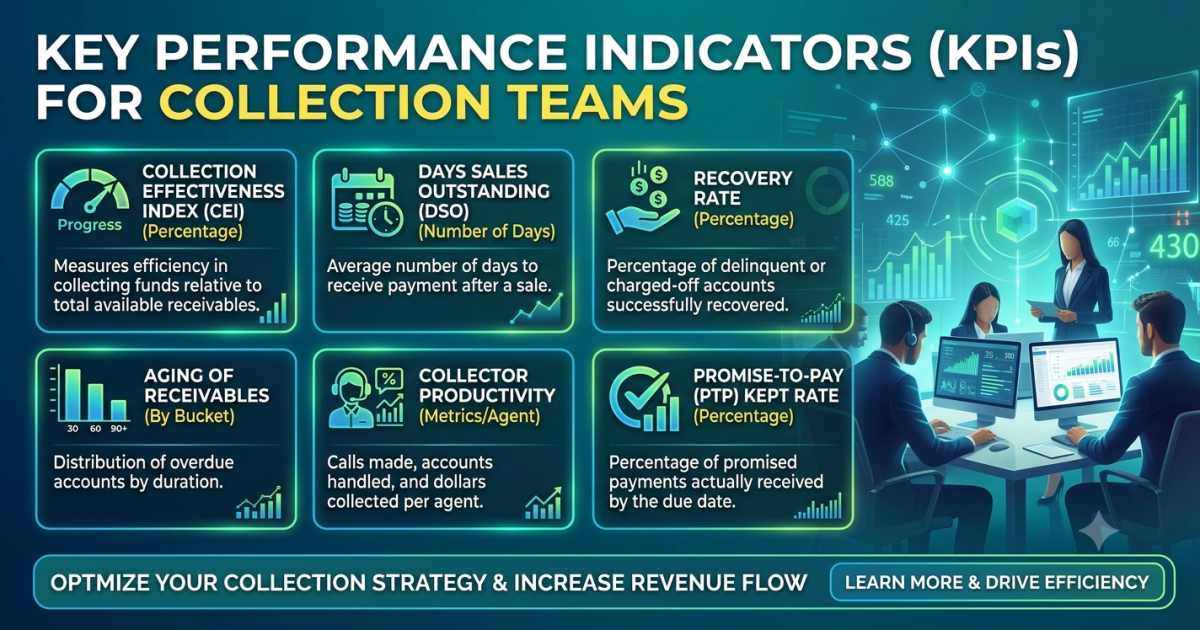
Key Performance Indicators (KPIs) for Collection Teams
Collection management is a crucial element of financial services. Banks, NBFCs, fintech companies, lenders, and other businesses need a proper collection process to make sure that payments will be made. However, just setting collection targets is not enough. Organizations need to monitor the performance of collection teams to assess what is working, what gaps exist in the process, and improve recovery results.
And this is where collection KPIs play a major role.
KPIs (or Key Performance Indicators) in collection management are quantitative metrics used to assess collection executives’ efficiency, productivity, quality, and performance.
By using the right collection KPIs, organizations can improve decision-making, increase team productivity, monitor overdue accounts, and implement a more structured collection strategy.
What Are KPIs in Collection Management?
Key Performance Indicators, or KPIs, are quantitative metrics that are used to assess performance against certain business objectives.
In the collection management, KPIs can help answer a lot of important questions such as:
- What outstanding amount has been recovered?
What is the number of accounts contacted?
How effectively the assigned collection goals are met?
- What is the number of payment commitments received from customers?
- What is the number of promises that have been fulfilled?
How quickly overdue accounts are recovered?
Which channels perform better?
Why Are Collection KPIs Important?
1.Measure Collection Performance
KPIs give a way to evaluate the performance of collection teams based on real data. Managers can assess recovery results, customer contacts, payment commitments, and other activities that are part of the collection process.
This gives an idea whether or not the collection operation is going toward business goals.
2.Increase Collection Team Productivity
Collection executives usually manage numerous accounts and follow-up actions. By monitoring KPIs, managers can identify the most productive employees, distribution of the workload, and identify the areas requiring additional training.
For example, if a certain executive makes a lot of customer contacts, but makes very few payment commitments, managers can identify that there might be an issue with the communication strategy and offer assistance.
3. Identify Operational Issues
Sudden decline in recovery rates or contact rates can be a signal of the problem with operations. There could be a variety of causes, such as outdated customer information, poor communication, lack of follow-ups, or issues with account allocation.
4. Assist with Data-Driven Decision Making
Collection management includes significant amount of customer and account data. With KPIs, operational data can be turned into performance insights.
Managers can use the insights to adjust collection strategy, prioritize accounts, allocate resources, and optimize follow-up processes.
Collection KPIs to Monitor Regularly
Every financial institution has its unique metrics depending on portfolio, strategy, and goals of the organization. The following collection KPIs are the most commonly used:
1. Collection Efficiency
Collection efficiency reflects the ability of the team to recover the amount that was targeted or expected to be recovered during a certain period of time.
Higher collection efficiency means that collection operation has achieved better recovery results against the assigned goal.
However, this metric should always be considered taking into account quality of portfolio, age of the account, customer segment, etc.
2.Recovery Rate
Recovery rate reflects the percentage of outstanding or targeted amounts that have been recovered.
For example, if a collection team was assigned a portfolio with ₹10 lakh collectible dues and the team recovered ₹7 lakh during the measurement period, the recovery rate against the defined base will be 70%.
3.Contact Rate
Contact rate shows how successfully collection teams reach the customers.
This metric can be calculated based on the successful contacts versus the total number of contacts, depending on the methodology defined by an organization.
Low contact rate might be an indicator of outdated customer data, poor communication, lack of follow-up, or issues with the account allocation.
4. Promise-to-Pay (PTP) Rate
Promise-to-Pay or PTP rate is a situation when a customer makes a commitment to make a payment by a certain date.
This KPI helps measure how often customer contacts lead to a payment commitment.
5. Promise Kept Rate
Making a payment commitment is not enough. A customer must also fulfill that commitment.
Promise Kept Rate is a metric that reflects how many payment promises are fulfilled within the agreed timeframe.
6. Right Party Contact (RPC) Rate
RPC is a situation when collection executives reach the right customer or authorized party.
7. Average Collection Amount
Average collection amount is a KPI that measures the average amount collected per account, customer, executive or per defined collection activity during a certain period of time.
This metric can help managers assess the productivity and compare recovery results of different teams or portfolios.
8. Cost per Collection
Collection operations include expenses such as salaries of employees, technologies, costs of communication, field visits, and administrative costs.
Cost per Collection is a metric that helps assess how much costs are associated with recovery of a certain amount.
9.Roll-Rate
Roll-rate is the metric that shows the movement of accounts from one delinquency stage to another over a certain period of time.
For example, if a certain account moves from the early delinquency bucket to a more severe stage of delinquency because the payment has not been made, it can be identified through roll-rate metric.
10.Bucket-Wise Recovery Rate
Different delinquency buckets can have very different recovery results.
Bucket Wise Recovery Rate KPI helps managers to assess how well the team is recovering the accounts in different buckets, such as early, mid, or late delinquency.
This information will help to develop the collection strategy.
KPIs for Field Collection Teams
Field collection teams require additional KPIs as their operations include field visits.
These KPIs can include:
Assigned Visits
- Visits Completed Successfully
- Contact Success Rate
- Amount Collected
- Payment Commitment Obtained
- Promise Kept Rate
- Productive Visits Rate
- Average Visits per Executive
- Cost Per Successful Visit
- Account Resolution Rate
These KPIs will help managers assess whether or not the field resources are utilized effectively.
How Technology Can Help in Tracking Collection KPIs
Modern collection management solutions can make collection KPIs monitoring faster and more accurate. Instead of using spreadsheets and other reporting tools, organizations can use centralized solution with dashboards to monitor collection activities.
The technology can help to collect information from different collection channels, such as tele-collection, field collection, digital payments, customer communication, etc.
Dashboards can show managers the following information:
Recovery Performance
- Productivity of Executives
- Status of Accounts
Payment Commitments
- Overdue Accounts
- Outcome of the Contacts
- Performance by Buckets
- Collection Targets
Then, this data can be analyzed to make decisions.
How Technology Can Help in Tracking Collection KPIs
For Dealz Management Technologies Pvt. Ltd. (DMT), KPI-based collection management can help to implement the structured approach to the collection operations.
KPIs will help managers to understand account level performance, productivity of employees, customer contact performance, payment commitments, recovery results.
At the same time, the properly designed KPI framework should not be focused solely on the amount collected. Compliance, communication quality, customer experience, accuracy of the data, operational efficiency and responsible collections practice should also be taken into consideration.
Such approach will help organizations to build sustainable collection operations instead of focusing on short-term recovery results.
Best Practices in Managing Collection KPIs
To make KPIs useful, organizations should follow the structured approach:
Identify the KPIs: Choose the metrics that will be useful for the collection goals.
Define the realistic targets: Targets should take into account portfolio quality, delinquency levels, customer segments, and historical performance.
Monitor KPIs: Regular daily, weekly, and monthly monitoring can provide different levels of operational insights.
Collect accurate data: Otherwise, incorrect or outdated information will lead to misleading performance results.
Compare Performance: Compare the results across teams, periods, buckets, products, and channels where appropriate.
Give Feedback: Results of KPIs should be used to identify the gaps in training and process improvement.
Avoid Focus on One Metric: Recovery Amount alone may not provide full picture of the performance of the collection team.
Consider Compliance and Quality: Collection activities should be professional, responsible, and compliant with applicable requirements.
Conclusion
Key Performance Indicators play a crucial role in the collection management. KPIs help financial institutions and collection service providers to measure performance, increase team productivity, identify operational issues, and make informed decisions.
Metrics like recovery rate, collection efficiency, contact rate, PTP rate, promise kept rate, RPC rate, cost per collection, roll-rate, and bucket wise recovery can provide a lot of insights into different aspects of the collection process.
With the right data, technology, analytics and processes, collection KPIs can help organizations to develop an efficient and measurable recovery strategy.
For financial institutions and collection management organizations like DMT, the proper KPI framework can bring greater visibility of the operations and more structured collection management.
Finally, proper KPI management is not only about measuring how much money is collected. It is about understanding how efficiently, consistently, responsibly and strategically the entire collection process is managed.
FAQs: Key Performance Indicators (KPIs) for Collection Teams
What are Key Performance Indicators (KPIs) in collection management, and why are they important?
Key Performance Indicators (KPIs) in collection management are measurable metrics used to evaluate the efficiency, productivity, and overall performance of collection teams. They help financial institutions, banks, NBFCs, and fintech companies monitor recovery results, customer contact rates, payment commitments, and overdue accounts. By tracking these indicators, managers can identify operational gaps, improve employee productivity, allocate resources effectively, and develop data-driven collection strategies.
What are the most important KPIs to measure collection team performance?
The most important collection KPIs include collection efficiency, recovery rate, contact rate, Promise-to-Pay (PTP) rate, Promise Kept Rate, Right Party Contact (RPC) rate, cost per collection, roll-rate, and bucket-wise recovery rate. Each metric measures a different aspect of the collection process. Together, they help managers understand how effectively teams contact customers, obtain payment commitments, recover outstanding amounts, and manage overdue accounts across different delinquency stages.
What is the difference between Recovery Rate and Collection Efficiency?
Recovery Rate measures the percentage of outstanding or targeted amounts successfully recovered during a specific period, based on the organization’s defined calculation method. Collection Efficiency evaluates how effectively a collection team achieves its expected or assigned recovery target. For example, if a team has ₹10 lakh in collectible dues and recovers ₹7 lakh, its recovery rate against that amount is 70%. Both metrics help assess collection performance, but they should also be evaluated alongside portfolio quality, account age, and delinquency levels.
How do Promise-to-Pay (PTP) Rate and Promise Kept Rate help improve collection performance?
Promise-to-Pay (PTP) Rate measures how often customer interactions result in a commitment to make a payment by an agreed date. Promise Kept Rate measures how many of those payment commitments are fulfilled within the agreed timeframe. Monitoring both metrics helps collection managers understand whether customer communication is generating meaningful commitments and whether those commitments are translating into actual payments. These insights can help teams improve follow-up schedules, identify missed commitments, and refine their collection strategies.
How does technology help financial institutions track collection KPIs effectively?
Technology helps financial institutions track collection KPIs through centralized collection management systems, real-time dashboards, automated reports, and digital account records. These tools provide visibility into recovery performance, executive productivity, customer contacts, payment commitments, overdue accounts, and bucket-wise recovery results. Managers can use this information to compare performance across teams and collection channels, identify operational issues, and make informed decisions. For organizations like Dealz Management Technologies Pvt. Ltd. (DMT), a structured, technology-supported KPI framework can help improve operational visibility while maintaining a focus on responsible collection practices, communication quality, and compliance.