
Data Privacy and Security in Collection Management
Collection management is an integral part of recovering overdue payments within the digital financial industry. Banks, Non-Banking Financial Companies (NBFCs), fintech, and other financial institutions are among companies that rely on collection management services to ensure the recovery of overdue sums of money. However, while working with customers’ loan details, financial institutions handle a great deal of personal information.
It is vital to protect customers’ data in order to provide a high level of protection and organize a responsible process of recovering overdue payments.
Data privacy and security in collection management mean all the actions, policies, and technologies which aim to protect private customer information. With the increasing digitalization of financial collection operations, it becomes essential to ensure a proper system of data handling.
For companies like Dealz Management Technologies Pvt. Ltd. (DMT) it is crucial to pay enough attention to privacy and security issues as they are a part of organizing professional and structured collection management process.
What Is Data Privacy and Security in Collection Management?
The main difference between data privacy and data security consists in what aspect they focus on. Data privacy ensures that customers’ information is collected, used, stored, and transferred only for the right purposes and by authorized persons.
Data security involves all the actions which protect the data from attacks, breaches, accidental loss, and any other types of threats.
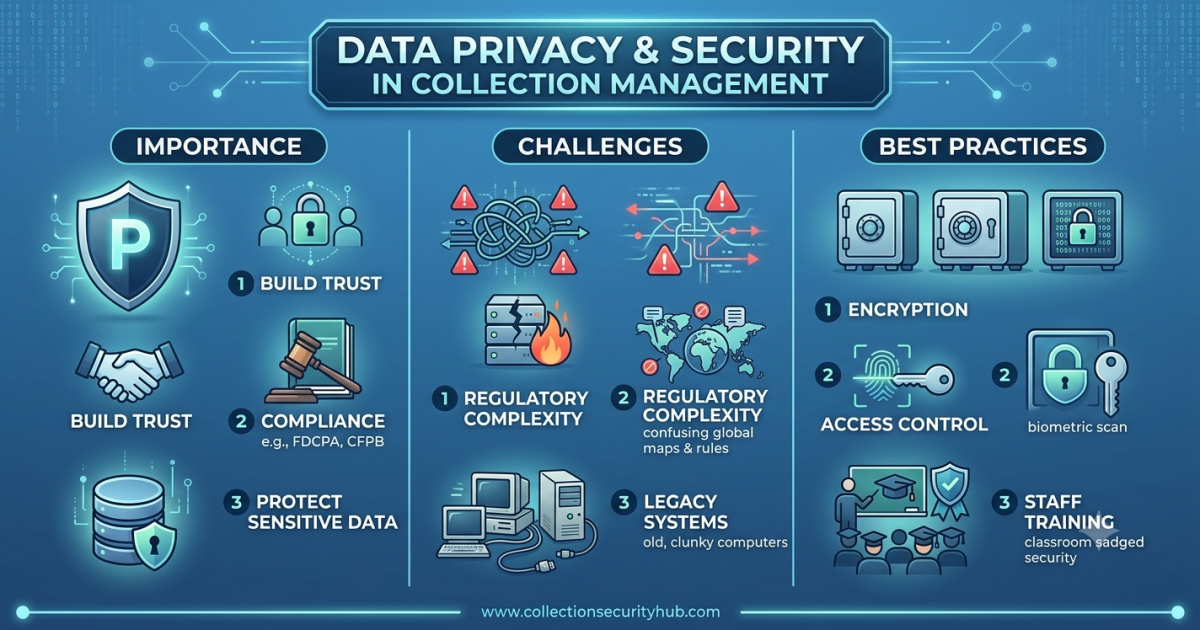
Why Is Data Privacy Important in Collection Management?
1. Protection of Sensitive Customer Information
In the course of collection operation, financial institutions have to deal with customers’ names, phone numbers, addresses, details of loan agreements, current debt, repayment information, and many other private pieces of data. The loss or misuse of any of this information can pose a significant threat to customers’ privacy and even finances.
2.Ensuring Customers’ Trust
It goes without saying that customers expect financial institutions and their service providers to protect their personal information from any kind of risk. Professional handling of customer information increases their trust towards the company.
3.Ensuring Regulatory Compliance
Every company operating in the financial sector has to comply with applicable legal requirements. In India, they may include the provisions of Digital Personal Data Protection Act, 2023, corresponding rules and notifications, and directions of the Reserve Bank of India (RBI) related to regulated lending institutions and their recovery practice.
It is important to review and follow all the requirements concerning data collection, processing, storing, transferring, and deleting.
4.Reducing the Risks of Breaches
Any unauthorized access to customer databases can cause information leakage and disruption of recovery process. Proper access control, security controls, employees training, and regular security assessment can significantly reduce these risks.
5.Protecting the Business Reputations
Any information breach or misuse can negatively affect the business’s image, its relationship with customers and other parties. The implementation of data privacy and security practices can help to reduce the risks of negative outcomes.
Common Data Privacy and Security Challenges in Collection Management
Some of the challenges which financial institutions can encounter in terms of handling customers’ information include:
1. Unauthorized access: Employees or any other party may access confidential information without the necessity.
2.Risks associated with data sharing: Sending customer’s information by insecure email, messaging application, or device can expose this information to a variety of risks.
3.Risks associated with inaccurate customer data: Outdated phone number, wrong address or any other inaccurate piece of data can result in improper communication.
4.Threats associated with cybersecurity: Phishing emails, malware, weak passwords, and other threats can threaten collection operation.
5.Risks associated with third-party providers: Any service provider (collection agency, technology provider, etc.) which processes customers’ data on behalf of financial institutions can cause the risk of misusing or breaching this data.
6.Employee mistakes: Forgetting to remove personal data, leaving papers on the desk or sending information to the wrong person can also lead to information leakage.
Best Practices for Data Privacy and Security in Collection Management
1. Implementation of Role-Based Access Control
Collection agents should have access to customers’ information only if it is necessary to perform their duties. Role-based access control will allow limiting access to only necessary data and prevent any misuse.
The permissions to access particular information should be reviewed regularly and removed in case if the employee changes his/her role or leaves the company.
2. Using Secure Data Storage and Encryption
Financial institutions should use reliable databases and other authorized systems to store customer information. Encryption will help to protect data during its transmission and in some cases – its storage.
Other necessary security controls include regular back-ups of data, secure transfers, and protection from unauthorized downloading.
3.Training Employees about Data Protection
It is important that employees are aware of the right ways to handle confidential information. Such training may involve the aspects of passwords protection, phishing awareness, confidentiality, proper communications, etc.
It is important to emphasize that collection executives know that customers’ data should not be shared with any unauthorized person or revealed publicly.
4. Collecting Only Necessitated Information
The collection of any additional information is not needed to recover payments. Therefore, companies should apply the principle of data minimization and collect only the reasonable amount of information which is needed for a particular purpose.
It will reduce the exposure of data and simplify its protection.
5. Verification of Customer Identity Before Information Sharing
Collection agents should check the identity of customers before discussing any details of the loan and debt. It will help to prevent any risks associated with disclosing information to unauthorized people.
6. Defining Policy of Information Retention and Deletion
Financial institutions have to retain customers’ information for a certain period of time which corresponds to applicable regulations and other requirements.
Once this period is over, and there is no reason to keep the information, it can be deleted if it is allowed.
7. Monitoring Third-Party Service Providers
If a company uses any third-party provider for the recovery of the debt, it should establish the policy regarding confidentiality, security measures, permitted actions, report of any incidents and access to the information.
Service providers should be periodically assessed to make sure that proper security controls are established.
8. Regular Security Assessment
It is important to conduct regular security assessments in order to find and fix any vulnerabilities in the system, employees behavior, and processes. It includes reviewing access logs, investigation of any suspicious actions, testing of security controls and elimination of any gaps found.
It is necessary to have the plan of reaction to any incident related to any kind of information leakage or unauthorized access.
Role of Technology in Protecting Collection Data
The use of technology can improve security and structure of the process of recovering payments. A secure collection management system allows centralizing customer records, establishing access controls, maintaining activity logs, and minimizing reliance on insecure spreadsheets and manual information sharing.
It is also possible to use such technologies as multi-factor authentication, encryption, cloud infrastructure, automation of access reviews, and real-time security monitoring.
It is necessary to note that the use of technologies alone does not provide information protection. It also requires trained employees, policies, monitoring, and implementation of security controls.
How DMT Can Help to Support Responsible Collection Management
Dealz Management Technologies Pvt. Ltd. (DMT) operates in the field of collection management and financial services support, and therefore the protection of information is an essential element of the collection process.
One of the steps in organizing collection management in a structured way is providing controlled access to customers’ information, establishing secure communication, proper documentation, employees’ awareness and monitoring of the process.
By integrating data privacy and security aspects into the collection process, service providers can support more structured operations as well as protect customers’ information.
Conclusion
Data privacy and security are two inseparable aspects of modern collection management process. Financial institutions deal with sensitive information every day, therefore it is important to ensure the protection of customers’ information during the whole collection process.
Using role-based access, secure storage, employees’ training, data minimization, verification of customer’s identity, monitoring of third-party service providers and regular security assessment will help to decrease information risks and organize the collection process responsibly.
For DMT and all the companies operating in the financial services sector, a focus on information protection will help to build customers’ trust, ensure regulatory compliance and organize the collection management process professionally and securely.
As the collection operations get more and more digitized, it is necessary to review the security practices regularly.
FAQs: Data Privacy and Security in Collection Management
What is data privacy and security in collection management?
Data privacy and security in collection management refer to the practices, policies, and technologies used to protect sensitive customer information. Data privacy ensures that information is collected and used appropriately, while data security protects it from unauthorized access, misuse, loss, and cyber threats.
Why is data privacy important in collection management?
Data privacy is important because collection teams handle sensitive information, including customer contact details, loan agreements, outstanding balances, and repayment records. Protecting this information helps maintain customer trust, reduce the risk of data breaches, support regulatory compliance, and protect business reputation.
What are the common data security challenges in collection management?
Common challenges include unauthorized access, insecure data sharing, outdated customer information, phishing attacks, malware, employee mistakes, and risks associated with third-party service providers. Implementing proper access controls, employee training, and regular security assessments can help minimize these risks.
What are the best practices for protecting customer data in collection management?
Best practices include implementing role-based access control, using encryption and secure data storage, training employees on data protection, collecting only necessary information, verifying customer identities before sharing loan details, establishing data retention policies, monitoring third-party providers, and conducting regular security assessments.
How does technology improve data privacy and security in collection management?
Technology improves data protection through secure collection management systems, encryption, multi-factor authentication, access controls, activity logs, automated monitoring, and secure data storage. These measures help financial institutions manage customer information more safely, reduce manual errors, and support a structured and responsible collection process.