
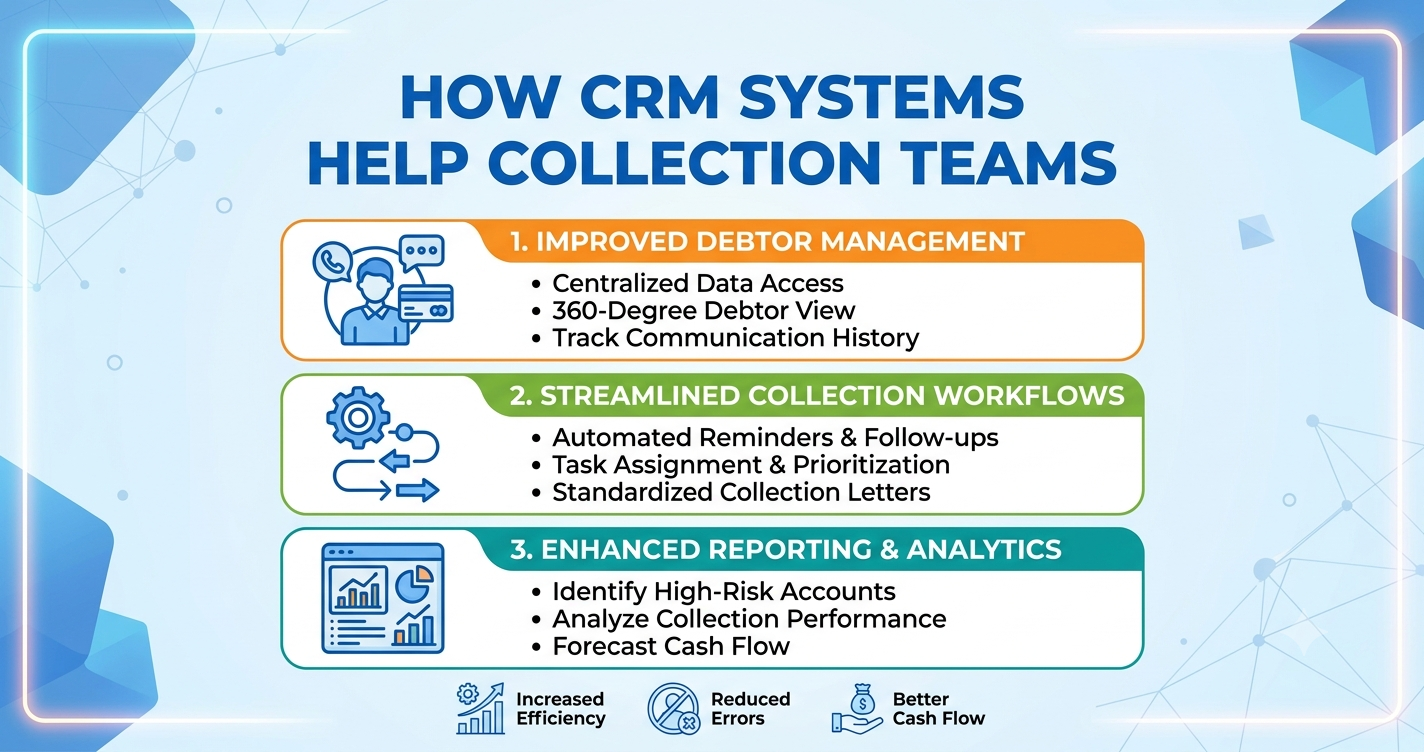
How CRM Systems Help Collection Teams | DMT
In the financial services industry, customer information management, overdue payment tracking, and follow-ups play a critical role in collection management. Banks, NBFCs, fintech, and collection agencies usually deal with many customer accounts. Manual management of these accounts is time-consuming and can lead to forgotten follow-ups and inaccurate information.
And this is where Customer Relationship Management (CRM) systems can help organizations to maintain customer information, track interactions, follow-ups, and collection.
For modern collection teams, CRM technology can become an effective solution to improve coordination and manage recovery.
What Is a CRM System in Collection Management?
Customer Relationship Management (CRM) is a platform for storing and managing customer information and interactions. When applied in the field of collection, a CRM system can help collection teams to organize account information, track communication history, schedule follow-ups, and track collection activities.
Depending on the particular system and its configuration, the collection CRM may contain the following information:
Customer contact details
Loan/account reference
Overdue payments
- Days past due (DPD)
- Collection bucket
- Previous communication record
Commitments for payment
- Follow-up dates
- Field visit record
- Collection results
With CRM systems, collection executives and managers can organize their activities better.
Why Are CRM Systems Important for Collection Teams?
Collection teams have to manage several accounts, communicate with customers, record payment commitments, and coordinate with other team members. Without a centralized solution, important information may be scattered in spreadsheets, email messages, paper documents, and separate communication systems.
A CRM system can help to organize all these data and make it accessible for authorized members of the team.
1. Centralized Customer Information
The first benefit of using CRM systems is centralized customer information.
Collection executives can view the account details on a single platform, instead of searching for the information in separate records. This information may include contact details, payment status, previous calls, outstanding payments, and others.
Centralization of the customer record can help team members understand the history of the account before communicating with the client. This can help to avoid repeating questions and provide more consistent conversation.
Access to customer information must be limited to authorized users in accordance with data protection requirements.
2. Follow-Ups
Follow-ups are an important element of any collection activities. But scheduling follow-ups and recording payment commitment manually is not easy.
CRM systems can help to schedule reminders, record follow-ups dates and monitor outstanding activities.
If the customer committed to make a payment at a certain date, a collection executive can record it in the system. Then, the team can check the account on this date and update its status.
This helps to reduce the possibility of forgetting about the follow-up date and to conduct more organized collection.
3. Improved Collection Team Productivity
Collection executives are usually responsible for several accounts within a single day. Searching and organizing the information for each of them takes some time.
But a well-configured CRM can help to simplify the routine work by combining the account information, communication history, assigned tasks, and follow-up schedule.
Some CRM platforms allow performing such tasks as automatic task assignment, automatic notifications, and workflow creation. With these features, the team can spend less time on administrative activities and pay more attention to customer interaction and account recovery.
Productivity improvement largely depends on the functionality of the particular system and how efficiently it is used.
4. Efficient Bucket-Wise Collection Management
Bucket-wise collection management is a common method to classify and manage overdue accounts. Usually, the collections are classified into early, mid, and late buckets depending on the Days Past Due (DPD).
If the CRM is connected to the appropriate data, it can help to track accounts in accordance with their delinquency level.
For example, the organization classifies overdue accounts into early, mid, and late buckets. And managers can track activities and follow-ups according to the internal policy.
CRM systems can also help to track account migration between the buckets and provide managers with more detailed information about overdue accounts and collection activities.
The structure of the collection buckets may differ from one lender and loan product to another.
5. Improved Communication and Interaction History
Effective communication is a crucial aspect of collection management. Collection teams need to know what was said during previous interaction and what was agreed with the client.
CRM systems can help to track interaction history, which includes call outcomes, customer responses, payment commitment, and follow-ups.
Before starting the next call, an authorized executive can check the interaction history and continue the conversation with more context.
This can help to improve customer communication and avoid repeating previous questions. Customer communication should always be performed in accordance with the regulations and organizational policies.
6. Field Collection Teams Coordination
CRM systems can also be useful in managing field collections.
Depending on the platform, field executives may access assigned accounts, account information, update visit results and record follow-up requirements via mobile application.
Managers can monitor the activities of field collection executives and coordinate the work with other collection team members.
For example, after visiting the customer and making notes about the visit, an executive can specify whether the customer was found, whether the payment discussion was held, and whether follow-ups will be required.
7. Real-Time Reporting and Performance Tracking
Managers need to track the performance of collection activities. CRM system with reporting functionality can help to track key performance indicators, such as:
Assigned accounts
- Completed follow-ups
- Outstanding amounts
- Collection amounts
Recovery rate
- Customer commitment
- Field visits
Account resolution status
This can help managers to identify pending activities, workload of team members, and collection results.
But performance indicators should be interpreted in connection with customer, portfolio, and other factors, not separately from them.
8. Data-Driven Collection Decisions
Combination of CRM data with analytics tools can help organizations to obtain new insights on the collection processes.
For example, managers can analyze the outcomes of follow-ups, customer account delinquency stage, payment history, recovery trends and identify the aspects that require additional attention.
These insights can be helpful in resource allocation and process evaluation.
But analytics should be performed in accordance with the law and organizational policies. Automation of recommendation generation must be combined with manual evaluation.
9. Improved Documentation and Accountability
Proper documentation is very important throughout the whole recovery cycle.
CRM can help to track assigned tasks, customer interactions, follow-ups and account status changes. Depending on the functionality, it can provide activity log and approval workflow features.
This can help managers to track completed tasks, customer account status and pending activities.
Documentation helps to monitor organizational processes in accordance with the regulations.
How DMT Can Benefit from Structured Collection Technology
Dealz Management Technologies Pvt. Ltd. (DMT) is a company, which operates in the field of collection and recovery management. In this area, organized customer account management, customer communication, follow-ups and monitoring of the performance is an important aspect of operations.
CRM systems can support these processes by helping the collection teams to organize the account documentation, track the account status, coordinate the collection activities and monitor performance.
Combining CRM technology with the appropriate processes, data analysis and professional customer communication can help to organize the debt collection process.
Conclusion:
CRM systems are widely used in modern collection management for organizing the customer information, scheduling follow-ups, managing the interaction history, organizing collection buckets, field collection management and monitoring of recovery performance.
Combining all this information on a single platform can help collection executives to organize their work better.
For financial institutions and collection service providers, the combination of CRM technology with data analysis, professional customer communication, documentation, and structured recovery process can help to organize the collection process more efficiently.
FAQs About CRM Systems
1. What Is a CRM System in Collection Management?
A Customer Relationship Management (CRM) system in collection management is a software platform that helps businesses organize customer information, manage overdue accounts, track payment commitments, and monitor collection activities. It allows collection teams to maintain important details, including customer contact information, outstanding balances, Days Past Due (DPD), previous communication records, and scheduled follow-ups in one centralized system. By keeping this information organized, CRM software helps collection executives manage accounts more efficiently, improve coordination, and maintain accurate records throughout the collection process.
2. How Do CRM Systems Help Collection Teams Improve Productivity?
CRM systems help collection teams improve productivity by simplifying routine tasks and providing quick access to customer account information. Instead of searching through spreadsheets, emails, and paper records, collection executives can access account details, previous interactions, payment commitments, and pending follow-ups from a centralized platform. Depending on the software, CRM systems may also offer automated reminders, task assignments, activity tracking, and performance reports. These features help teams manage multiple accounts, reduce manual administrative work, and focus more on customer communication and timely follow-ups. The overall improvement depends on the CRM’s features, data quality, and how effectively the organization uses the system.
3. What Are the Benefits of Using CRM Software for Debt Collection?
CRM software offers several benefits for debt collection, including centralized customer information, organized follow-ups, improved communication, better account tracking, and more efficient team coordination. It helps collection executives maintain interaction histories, record payment commitments, monitor overdue balances, and identify pending activities. Managers can also use CRM reports to review collection performance, track recovery trends, and understand team workloads. Additionally, CRM systems may support bucket-wise collection management by organizing overdue accounts according to their Days Past Due (DPD). When combined with appropriate workflows, data security measures, and professional communication practices, CRM software can help financial institutions, banks, NBFCs, and collection agencies manage their collection operations more systematically.
4. How Does CRM Software Help Improve Debt Recovery?
CRM software supports debt recovery by helping collection teams maintain accurate account information, prioritize overdue accounts, schedule timely follow-ups, and track customer responses. For example, when a customer commits to making a payment on a particular date, the collection executive can record the commitment and schedule a follow-up accordingly. If the payment remains pending, the team can review the account and take the next appropriate action under its internal policies. CRM systems can also help managers monitor recovery performance, review communication histories, and identify accounts requiring additional attention. Although CRM software cannot guarantee successful recovery, it can improve process visibility, documentation, and coordination, supporting a more structured debt recovery process.
5. How Can CRM Software Help Manage Overdue Payments and Collection Buckets?
CRM software helps organizations manage overdue payments by maintaining account balances, tracking payment status, recording follow-up activities, and organizing accounts according to their Days Past Due (DPD). Collection teams may classify overdue accounts into early, mid, and late collection buckets based on their internal policies and the applicable loan product. This classification helps executives and managers understand the stage of delinquency and plan appropriate follow-up activities. A well-configured CRM system can also record customer communication, payment commitments, field visit outcomes, and changes in account status. With reporting and monitoring features, managers can identify pending accounts, review collection trends, and allocate resources more effectively. The exact bucket structure and follow-up process may vary between financial institutions and lending organizations.